
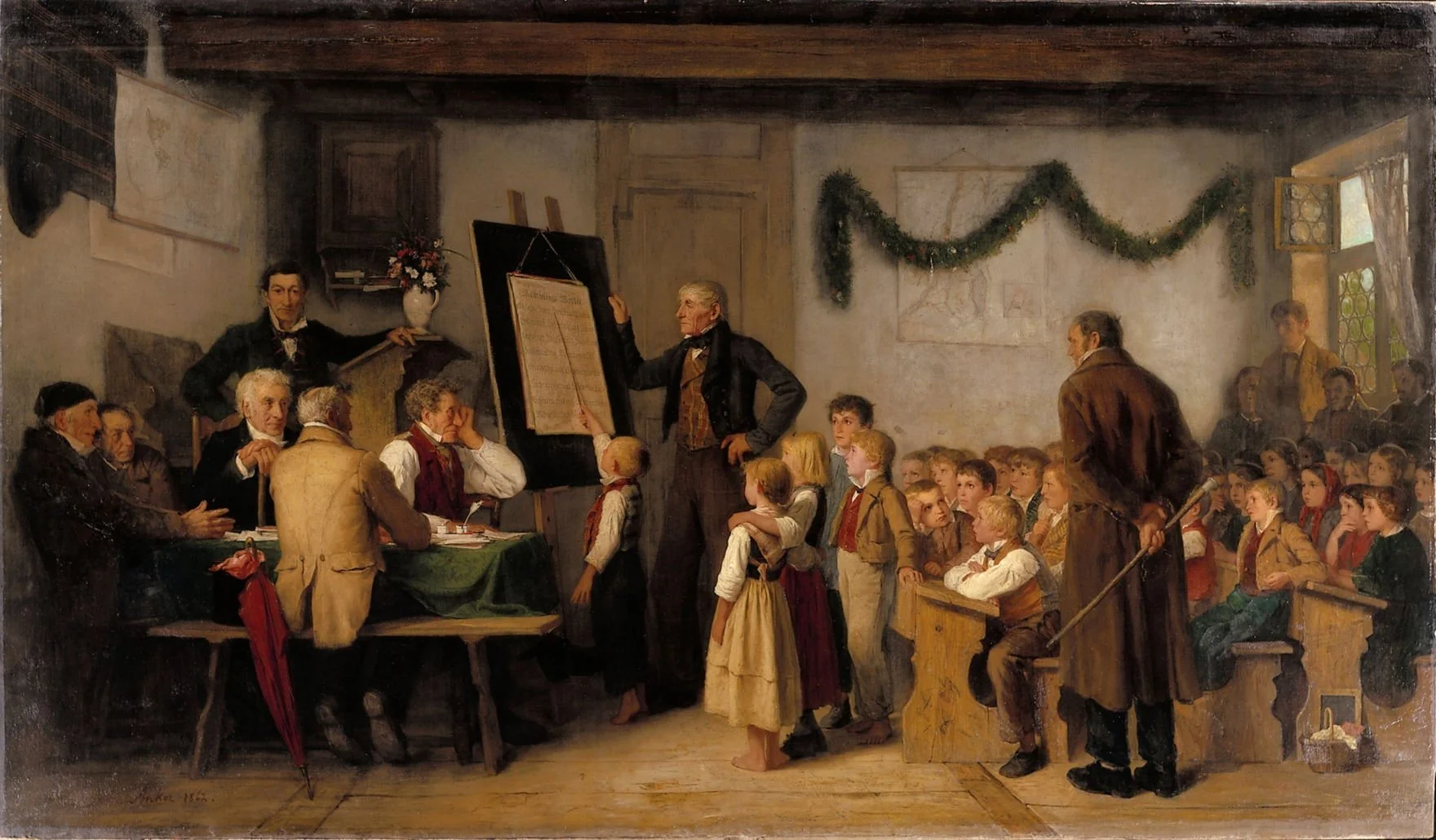
Christian Education
Ephesians 6:1–4
Children, obey your parents in the Lord, for this is right. “Honor your father and mother” (this is the first commandment with a promise), “that it may go well with you and that you may live long in the land.” Fathers, do not provoke your children to anger, but bring them up in the discipline and instruction of the Lord.
Learning to Love
-
It is formation of the whole person, body and soul, by a sanctified lifting of the affections and expansion of the imagination to behold the glories of Christ. The true vision of Christ in his beauty springs forth abundant lives of godliness and fruitful obedience. As Samuel Taylor Coleridge observed, “In the education of children, love is first to be instilled, and out of love obedience is to be educed.”
-
God’s Word in Deuteronomy, Proverbs, and Ephesians tells parents it is their responsibility to teach, educate, train, correct, and disciple their children in loving wisdom for the purpose of forming mature disciples of Christ. Church-based training, homeschool co-ops, and academies provide the opportunity for parents to partner together to accomplish shared educational goals. These educational programs do not replace the God-given responsibility of the family and church but enhance and serve them.
-
Both teaching and learning are acts of worship. In this sense, Christian education is a project of growing, developing, and equipping worshippers to worship well the Triune God. Right orientation with God puts us in the right orientation with everything else. Our approach to education is built on foundational biblical principles like the ones found here. Building upon the foundational truth that all things are from, through, and for the Lord and that it is Christ who holds all things together by the power of his word, education is growing in an awareness and appreciation of how all things cohere in Christ and then living in accordance with his design and order. All true learning is growing in the knowledge of God – who he is, who we are, what kind of world this is, and how to live in light of these realities. All disciplines and industries are taking the raw materials of creation and rearranging and re-orienting them into goods and services fitted for their purpose of praising God.
Redeeming Series: History, Mathematics, Language, Science, Sociology, Logic, Reason, Philosophy.
-
The standard of greatness can be established in numerous ways: Does it endure? Is it influential? Is it true to reality? This kind of classical education is a study of great men who did great things, great thinkers who thought great thoughts, and great books which deal with great matters. We want to train greatness into our children so that they can enter into the great conversation and become great men and great women. The standard by which we measure greatness is Christ. Ultimately, we measure all things by Christ and his Holy Word for he is what is true and transformative and eternal. And so, we approach education classically—great men, great ideas, great books—and Christianly—obeying the great commandment and fulfilling the great commission in worship of the great Christ.
-
The content of this education is the revelation of God in Christ from Scripture and in Creation. Reality is made of words, both words of language (trivium) and words of number (quadrivium). The opening of Scripture tells us, “God said . . . and it was so.” And his creative speaking is recorded by the numbering of days. The liberal arts, when properly understood and employed, are the best tools for making mature Christian disciples. These time-tested arts provide training to the liberated. Liberated from what? The shame and shackles of sin! And liberated for what? Forgiveness in Christ frees us to pursue the life of free men under the Father’s care, devoted to the Word, and walking in the Spirit. This is how we develop our children to excel as rational, moral, and social beings by thinking well, writing well, speaking well, as well as loving and living well.
-
Education involves the contemplative and the active life. The common arts, also known as the mechanical or manual arts, are the arts of an active body. Common arts are the work of productive households and involve: Agriculture, Tailoring and Weaving, Metalworking, Woodworking, Leather Working, Stonemasonry, Navigation, Medicine, Culinary, Armament and Hunting, Animal Husbandry, Architecture, and Trade.
-
The goal of teachers is to train students to become more faithful, virtuous, and loving that they would learn to delight in the truth, beauty, and goodness of God. Teachers encourage this by promoting truth, training character, and stirring affections to engage with God’s Word and God’s world. As parents and teachers, our aim is to facilitate environments of learning and cultivate cohorts of neighbor-love. We do this by genuinely caring for our students and being sensitive and responsive to their current stage of development. Our role is to train students to decipher, process, and critically assess information. We do this by directly engaging with great thinkers, influential works of literature, and the history of ideas and their consequences as an ongoing project with the great tradition of Christian education.
Important aspects of this kind of Christian education and discipleship include:
Aiming for wholistic development and spiritual transformation. (Deut 6:1–9)
Setting our own hearts to study, live, and teach truth. (Ezra 7:10)
Equipping students to discern weightier matters. (1 Sam 15:22; Prov 21:3; Matt 23:23)
Training students to observe all things that Christ commanded. (Matt 28:20; John 14:15)
Equipping students to increase in wisdom, stature, and in favor with God and man. (Luke 2:52)
Teaching with kindness, patience, and gentleness in hope that God would grant repentance leading to a knowledge of the truth. (2 Timothy 2:24–26)
This kind of Christian and classical education trains students in knowledge, understanding, and wisdom to embody the virtue and wisdom of Christ. The goal of this education is to form disciples of Christ who recognize, appreciate, and value God’s glory in Christ Jesus, to grow in holy affections of love for God and their neighbors, and to walk in wisdom according to God’s Word.
-
Which one are you? Modern popular culture has pitted loving against fighting. On one hand you may incline to the sappy, syrupy, sentimental goo of emotive passion or you might default to a cantankerous, fault-finding, rabble-rousing kind of harsh, put-em-up antagonism. But what if the options were not exclusive? And what if they were expanded to include the virtuous kinds of loving and fighting? The questions we need to ask are: Lovers of what and whom? And fighters against what and whom? The direction of our love and our fighting makes all the difference.
We want our children to be lovers and fighters. And when things are properly ordered, we want them to love to fight as they fight for love. We want them to be lovers of virtue who fight against vice and defenders of love who fight for virtue. As Chesterton said, “The true soldier fights not because he hates what is in front of him, but because he loves what is behind him.” True love and proper fighting are inseparable. For that which you will not fight for, you do not truly love. Augustine made the case that true virtue is the right ordering of our loves. And that right ordering is to love God entirely—soul, mind, strength—and your neighbor as yourself.
Fighting takes many forms. And it is the work of wisdom to know what fighting style is called for in each situation. Whether the fight be physical or rhetorical, planned for or sudden, minor or major, they are all, at bottom, spiritual. And this is why we must judge the justness of each conflict by its cost and benefit to our God-ordered loves.